Bootstrapping vs Venture Capital: Key Differences
Starting a business requires capital, but founders do not always need to raise money from outside investors. Some entrepreneurs build their companies using their own savings and business revenue. This approach is known as bootstrapping.
Another option is to raise equity funding from venture capital (VC) firms. Venture capital can provide substantial capital for startups with strong growth potential, but founders generally give up a portion of ownership and may have investors involved in important business decisions.
Both approaches have advantages and limitations. The right choice depends on the startup’s business model, capital requirements, growth plans and the founder’s objectives.
What Is Bootstrapping?
Bootstrapping means building and operating a business primarily with the founder’s own money and the revenue generated by the business.
For example, an entrepreneur may use personal savings to develop a website, launch a product, acquire the first customers and then reinvest the revenue into the business.
Common sources of bootstrapped capital include:
- Personal savings
- Business revenue
- Reinvested profits
- Friends and family
- Customer advances
- Pre-orders
The main characteristic is that the startup does not depend primarily on institutional equity investors to finance its growth.
What Is Venture Capital?
Venture capital is a form of equity financing in which professional investment firms provide capital to startups in exchange for an ownership interest or another agreed investment structure.
VC firms generally invest in businesses with the potential for substantial growth and scalability. Startup India identifies venture capital funds as a source of funding for startups, particularly as companies move from validation and early traction toward scaling.
VC funding may be used for:
- Product development
- Hiring
- Marketing
- Technology
- Geographic expansion
- Sales infrastructure
- Acquisitions
- Scaling operations
Unlike a traditional loan, venture capital does not normally require scheduled repayment of principal. However, founders share ownership and may have to accept investor rights and governance conditions.
Bootstrapping vs Venture Capital: Key Differences
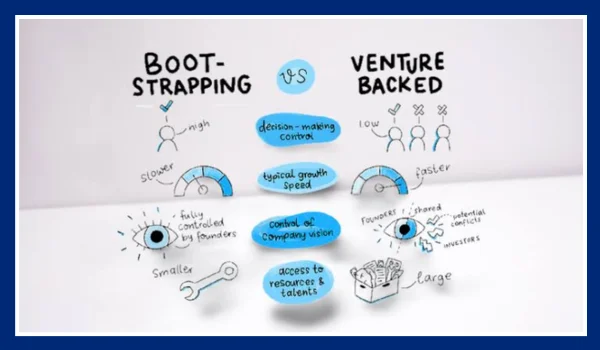
| Factor | Bootstrapping | Venture Capital |
| Source of funds | Founder money and business revenue | Investment from VC funds |
| Ownership | Founder generally retains greater ownership | Ownership is shared with investors |
| Repayment | No investor repayment | No traditional loan repayment |
| Control | Usually greater founder control | Investors may receive governance rights |
| Growth speed | Depends on internal cash generation | Can accelerate growth with external capital |
| Financial pressure | Strong focus on cash flow | Pressure to achieve agreed growth objectives |
| Fundraising | Usually limited external fundraising | Requires investor fundraising |
| Investor involvement | Limited | Can be significant |
| Suitable for | Many capital-efficient businesses | High-growth and scalable businesses |
These are broad differences. Individual funding arrangements can vary considerably.
- Ownership and Equity
One of the biggest differences is ownership.
When founders bootstrap, they generally retain ownership of the company, although ownership can also be shared with co-founders or other early participants.
When a startup raises VC funding, investors typically receive an ownership interest or an equity-linked instrument.
For example, if a founder raises capital by selling a percentage of the company, the founder’s ownership percentage decreases.
This is known as equity dilution.
Founders should therefore consider not only how much capital they need but also how much ownership they are prepared to give up.
- Control Over the Business
Bootstrapping generally allows founders to maintain greater control over business decisions.
A founder can decide:
- Which products to develop
- Which customers to target
- How quickly to expand
- How much profit to reinvest
- Whether to enter a new market
VC investors may have certain rights depending on the investment agreement. These can include board representation, information rights, protective provisions or approval rights over specific major decisions.
The exact rights depend on the terms negotiated between the startup and investors.
- Growth and Expansion
VC funding can provide substantial capital that allows a startup to invest aggressively in growth.
For example, a technology startup could use VC funding to hire engineers, expand its sales team and enter multiple markets.
A bootstrapped company generally has to match expansion with available cash flow.
This can result in slower expansion, but it may also encourage founders to focus on sustainable revenue and operating efficiency.
- Financial Discipline
Bootstrapping often requires strict financial management.
Because the company is using limited internal resources, founders may need to prioritise expenses carefully.
They may ask:
- Does this expense generate revenue?
- Can the business operate with a smaller team?
- Can a product be launched with fewer features?
- Can existing customers generate additional revenue?
VC-backed companies may have more capital available, but having more money does not eliminate the need for financial discipline.
- Investor Pressure
Bootstrapping does not normally involve external equity investors, so founders do not have to meet investor expectations regarding growth or future funding rounds.
VC-backed startups may have investors who expect the business to achieve specific growth objectives.
Investors may also have a target investment horizon and eventually seek a liquidity event such as a company sale or public listing.
This does not necessarily mean every VC-backed startup must follow the same path, but founders should understand the expectations before accepting funding.
- Access to Networks and Expertise
VC funding can provide benefits beyond capital.
A VC firm may offer access to:
- Industry experts
- Potential customers
- Future investors
- Hiring networks
- Strategic partners
- Experienced advisors
Bootstrapped founders may need to build these networks independently.
However, a bootstrapped entrepreneur can also gain expertise through mentors, professional networks, incubators and industry associations without giving away company equity.
- Risk for the Founder
Bootstrapping can expose the founder to greater personal financial risk if personal savings are used to finance the company.
If the business fails, the founder may lose some or all of the money invested.
With equity funding, the founder is generally not personally required to repay the investor simply because the startup fails. However, the founder gives up part of the company’s ownership and may have contractual obligations under the investment documents.
Founders should distinguish equity financing from personal guarantees and debt obligations.
When Is Bootstrapping Suitable?
Bootstrapping can be considered when:
- Startup costs are relatively low
- The business can generate revenue quickly
- Customers are willing to pay early
- Growth can be funded through operating cash flow
- The founder wants greater control
- The company does not require large upfront investment
Service businesses, consulting companies, niche software products and certain online businesses may be capable of starting with relatively limited capital, although every business is different.
When Can Venture Capital Be Considered?
VC funding may be considered when:
- The market opportunity is large
- The business model is scalable
- Significant capital is required
- The startup has demonstrated traction
- The company needs rapid expansion
- The founders are comfortable sharing ownership
- External expertise and networks can add value
VC funding is generally designed for businesses with substantial growth potential rather than every type of small business.
Bootstrapping vs VC: Questions Founders Should Ask
Before choosing a funding strategy, founders can consider:
- How much capital does the business actually need?
- Can the company generate revenue without external equity?
- How quickly does the business need to expand?
- How much ownership are the founders willing to dilute?
- Do external investors bring useful expertise or networks?
- What level of control do the founders want to retain?
- What are the long-term plans for the business?
- Can the business comfortably operate with its expected cash flow?
Answering these questions can help founders evaluate funding options more realistically.
Can a Startup Bootstrap and Later Raise VC?
Yes.
A startup can begin with founder capital and revenue and later raise venture capital when it reaches a stage where external funding can accelerate expansion.
Bootstrapping before fundraising can allow founders to demonstrate:
- Product-market validation
- Revenue
- Customer demand
- Retention
- Business economics
- Early growth
This evidence may help investors understand the company’s progress, although investment decisions remain specific to each investor and startup.
Frequently Asked Questions
Is bootstrapping better than venture capital?
Neither approach is universally suitable. Bootstrapping provides greater control but may limit the amount of capital available for rapid expansion. VC can provide growth capital and investor networks but involves equity dilution and potential investor involvement.
Do bootstrapped startups have investors?
They may have founders, co-founders, friends and family or other non-institutional investors. The defining feature is that the business relies primarily on internal or founder-controlled resources rather than institutional venture capital.
Does venture capital have to be repaid?
Traditional equity VC investment does not work like a conventional loan with scheduled principal repayment. However, investors receive economic and contractual rights associated with their investment.
Can a small business raise venture capital?
It can, but VC investors generally look for businesses with significant growth and scalability potential. A profitable small business may instead find bootstrapping, bank financing or other funding sources more aligned with its needs.
Can bootstrapping make a startup profitable?
It can, but profitability depends on the business model, pricing, costs, demand and execution. Bootstrapping itself does not guarantee profitability.
Conclusion
Bootstrapping and venture capital represent two different ways of financing startup growth. Bootstrapping generally offers greater ownership and control, while VC funding can provide substantial growth capital, investor expertise and business networks.
The decision should be based on the startup’s capital requirements, scalability, growth plans, cash flow and ownership objectives. Founders should also consider whether external capital will create meaningful value for the business before giving up equity.