ETF vs Mutual Fund: Key Differences
Exchange-Traded Funds (ETFs) and mutual funds are popular investment options that allow investors to gain exposure to a basket of securities instead of investing directly in individual stocks or bonds.
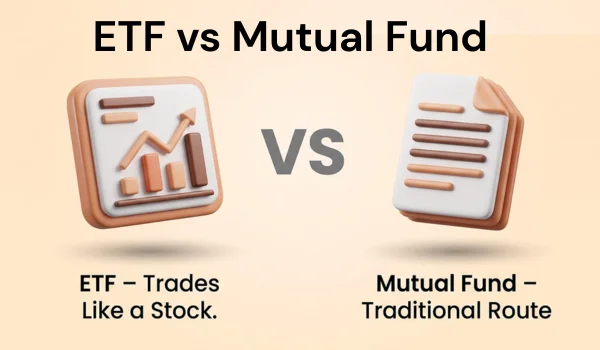
Although both can provide diversification, they work differently. ETFs are traded on stock exchanges like shares, while mutual fund units are generally bought or redeemed through the mutual fund or a distributor/platform at the applicable Net Asset Value (NAV).
The right choice depends on factors such as investment style, trading requirements, costs, liquidity, investment amount and convenience.
What Is an ETF?
An Exchange-Traded Fund (ETF) is an investment fund whose units are listed and traded on a stock exchange.
An ETF can track an index such as the Nifty 50 or Sensex, or provide exposure to other asset classes such as bonds, commodities or specific market segments.
Because ETFs trade on an exchange, their market price can change throughout the trading session.
For example, a Nifty 50 ETF aims to track the performance of the Nifty 50 Index, subject to expenses and tracking differences.
What Is a Mutual Fund?
A mutual fund pools money from multiple investors and invests it according to the scheme’s investment objective.
Mutual funds can invest in:
- Equity
- Bonds
- Money-market instruments
- Gold and other permitted assets
- A combination of asset classes
Investors buy units based on the applicable NAV and the rules of the particular scheme.
Mutual funds include actively managed funds as well as passive index funds.
ETF vs Mutual Fund: Key Differences
| Feature | ETF | Mutual Fund |
| Trading | Traded on stock exchanges | Purchased/redeemed through fund mechanisms |
| Price | Market price changes during trading | Transactions generally occur at applicable NAV |
| Demat account | Generally required for exchange-traded ETFs | Not generally required |
| Investment method | Buy/sell through a broker | Directly through AMC/platform/distributor |
| Intraday trading | Possible | Generally not available |
| Active management | Many ETFs are passive | Can be active or passive |
| SIP | Possible through some platforms/brokers, depending on setup | Widely available |
| Liquidity | Depends on exchange trading volume | Redemption depends on scheme rules |
| Costs | Expense ratio + brokerage/other trading costs | Expense ratio and applicable transaction costs |
| Minimum investment | Depends on market price and broker/order | Depends on scheme requirements |
How ETFs and Mutual Funds Are Bought
Buying an ETF
An ETF is bought and sold on a stock exchange through a trading account.
The investor generally places an order just as they would when buying shares.
The transaction takes place at the market price available when the order is executed.
Therefore, an ETF’s trading price can be slightly different from its underlying NAV.
Buying a Mutual Fund
Mutual fund units can generally be purchased directly from the Asset Management Company (AMC) or through eligible investment platforms and distributors.
The applicable NAV is determined according to the scheme’s rules and applicable regulatory requirements.
Unlike an ETF, investors generally do not need to watch the stock market during the day to place a mutual fund purchase or redemption order.
ETF vs Mutual Fund: Trading Price
One of the biggest differences is how prices work.
ETF prices fluctuate during market hours because ETFs trade on exchanges.
Suppose an ETF’s underlying portfolio has an indicative value of ₹100 per unit. The ETF might trade slightly above or below that level depending on market demand, supply and liquidity.
Mutual fund transactions generally happen at the applicable NAV rather than a continuously changing exchange price.
This difference can matter to investors who want to control the price at which they enter or exit an investment.
Active vs Passive Investment
ETFs are often associated with passive investing, where the fund attempts to track an index or benchmark.
However, ETFs are not necessarily passive in every case.
Mutual funds can be either:
- Actively managed, where the fund manager selects investments
- Passively managed, where the fund attempts to track an index
Therefore, comparing an ETF with “mutual funds” as a single category can sometimes be misleading.
An index mutual fund and an index ETF may have similar investment objectives but different methods of buying and selling units.
Expense Ratio and Other Costs
The expense ratio represents the expenses charged by a fund for managing and operating the scheme.
Investors should not compare only the expense ratio.
For ETFs, investors may also incur costs associated with buying and selling units through a broker. The bid-ask spread can also affect the effective transaction cost.
For mutual funds, the total cost can depend on factors such as the scheme, plan selected and applicable transaction charges.
The actual cost should therefore be assessed based on the specific ETF or mutual fund rather than assuming one category is always cheaper.
ETF vs Mutual Fund for SIP
Systematic Investment Plans (SIPs) are widely used with mutual funds.
Investors can set up a fixed periodic investment, such as ₹5,000 every month, subject to the scheme and platform’s facilities.
ETFs can also be accumulated periodically, but the process is different because ETF units are traded on an exchange. The investor needs to purchase units through the market, and the number of units purchased can depend on the ETF’s market price.
Some brokers and platforms offer facilities for recurring ETF investments, but availability and features vary.
Liquidity Difference
Liquidity is another important factor.
An ETF can be bought or sold during market hours, but the ease of execution depends on the trading volume and market depth of that particular ETF.
A heavily traded ETF may have a relatively narrow bid-ask spread, while a less actively traded ETF may have a wider spread.
Mutual funds generally allow investors to redeem units according to the scheme’s applicable redemption rules, although certain schemes can have exit loads, restrictions or other conditions.
Therefore, investors should check the specific product before investing.
ETF vs Mutual Fund: Taxation
Taxation depends on the underlying assets and the type of fund rather than simply whether the investment is an ETF or mutual fund.
For example, equity-oriented ETFs and equity-oriented mutual funds can generally fall under similar capital-gains tax provisions when the applicable conditions are satisfied.
For transfers on or after 23 July 2024, eligible equity-oriented investments generally have a 20% short-term capital-gains rate, while eligible long-term capital gains under Section 112A are taxed at 12.5% on gains exceeding ₹1.25 lakh in a financial year, subject to applicable conditions.
Other ETFs, such as debt-oriented or commodity-focused products, can have different tax treatment depending on their classification and acquisition date.
Therefore, investors should check the specific fund’s tax classification before making investment decisions.
ETF vs Mutual Fund: Which Is More Flexible?
ETFs offer several trading-related features:
- Real-time buying and selling
- Limit orders
- Market orders
- Intraday trading
- Exchange-based price discovery
These features can be useful for investors who are comfortable with market trading.
Mutual funds focus more on investment convenience. Investors can typically automate SIPs, select growth or IDCW options where available, and invest without actively monitoring market prices during the trading session.
Advantages of ETFs
ETFs can offer:
- Exchange-based trading
- Real-time prices
- Access to diversified portfolios
- Convenient exposure to indices or specific asset classes
- Potentially low ongoing costs for certain products
However, investors should check liquidity, tracking difference, expense ratio and trading costs.
Advantages of Mutual Funds
Mutual funds can offer:
- Easy SIP facilities
- Professional management in active funds
- Wide range of schemes
- Automatic investment options
- No need for intraday trading
- Options for both active and passive strategies
The costs, investment strategy and risk level can vary considerably between schemes.
ETF vs Mutual Fund: What Should Investors Consider?
Before choosing between the two, consider:
Investment Objective
Identify whether you want index exposure, active management or a particular asset class.
Investment Amount
Check the ETF’s market price and the mutual fund’s minimum investment requirement.
Trading Preference
If you want exchange-based buying and selling, an ETF may fit that requirement.
SIP Requirement
If automated monthly investing is important, check the SIP facilities available for the product.
Liquidity
For ETFs, check average trading volume and bid-ask spreads.
Costs
Look beyond the expense ratio and consider all applicable transaction costs.
Taxation
Check the specific fund’s tax classification and the applicable capital-gains rules.
Frequently Asked Questions
Is an ETF better than a mutual fund?
ETFs and mutual funds have different structures and features. The more suitable option depends on factors such as investment objective, trading preference, SIP requirements, liquidity and costs.
Can I invest in an ETF without a Demat account?
Exchange-traded ETFs generally require a Demat and trading account because their units are bought and sold on a stock exchange.
Are ETFs cheaper than mutual funds?
Some ETFs have low expense ratios, but the overall cost also depends on brokerage, bid-ask spread, tracking difference and other applicable charges. It is better to compare the complete cost structure.
Can I do SIP in ETFs?
Periodic ETF investing is possible, but the mechanism differs from a traditional mutual fund SIP. Availability of automated recurring purchases depends on the broker or investment platform.
Are ETFs and mutual funds taxed differently?
Not necessarily. Tax treatment primarily depends on the nature and classification of the investment. Two products with similar underlying assets can have similar tax treatment, subject to applicable rules.
Are ETFs good for beginners?
ETFs can provide diversified exposure, but investors should understand exchange trading, bid-ask spreads, market orders and the specific ETF’s underlying asset before investing.
Conclusion
ETFs and mutual funds both provide a way to invest in a diversified portfolio, but their structures are different. ETFs trade on stock exchanges at market prices, while mutual fund transactions generally take place at the applicable NAV.
ETFs may appeal to investors who prefer exchange-based trading, while mutual funds can be convenient for investors who want features such as automated SIPs and professional management. Before investing, compare the specific product’s objective, costs, liquidity, risk, taxation and investment method rather than choosing solely based on the product category.